
Some projects start with a brief that changes everything.
“We have a 3D printer. It’s attached to a satellite. It prints rigid structures directly in orbit. We need people to understand what that means.”
That’s exactly what Orbital Matter — a startup founded in 2022 in Warsaw — brought to me. And it’s exactly the kind of challenge where 3D animation isn’t a communication luxury. It’s a technical necessity.
The problem they solve
Next-generation constellations, space data centers, and high-power communication systems all share the same need: solar arrays, radiators, and antennas far larger than what can be folded into a fairing and survive launch.
The structural limit is no longer a design problem. It’s a manufacturing location problem.
Orbital Matter’s answer is as simple to state as it is complex to execute: build structures directly in orbit.
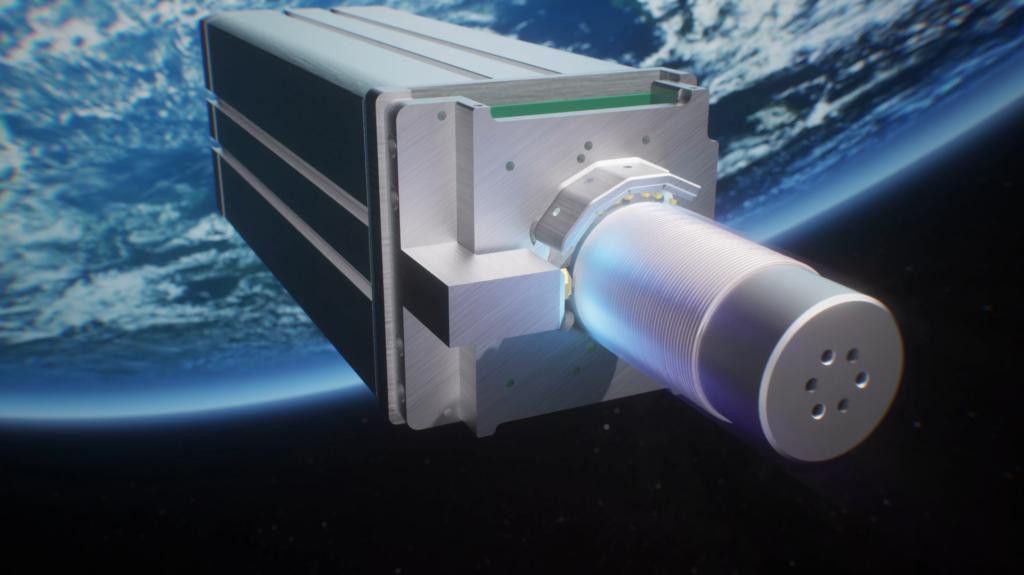
Their system — PADS, the Printer Assisted Deployment System — is a compact, self-contained module that integrates with most existing satellite platforms. It stores photopolymer resin in liquid form, extrudes it through a precision head, and cures it instantly with UV light in the vacuum of space.
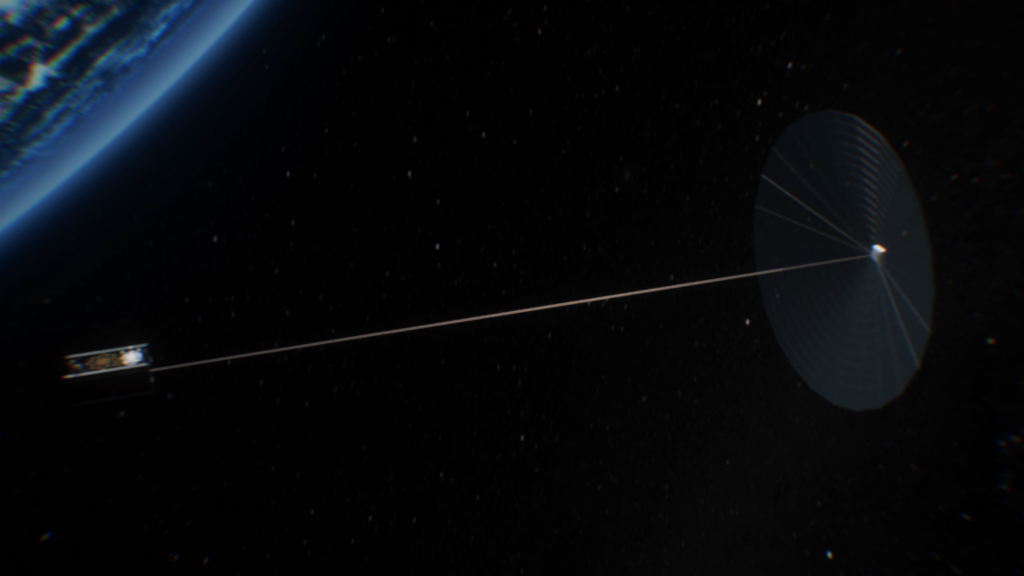
The result: a continuous, rigid structure with no joints or mechanical connections. Size is limited only by the amount of raw material carried. A single motor. Power consumption lower than a light bulb.
The animation challenge: making visible what isn’t in orbit yet
When Orbital Matter reached out, their printer existed, worked, and the technology was validated — but it wasn’t in orbit yet. No 50-meter structure to film in space.
3D animation was the only medium capable of showing their technology at real scale — comprehensible, credible, and fundable.
The film is structured in two parts.
Part one: the system in action. We follow the printer module attached to its satellite, then the printing process itself — liquid photopolymer resin extruded layer-by-layer and immediately cured into a rigid cylindrical boom, capable of exceeding 50 meters in length. Long enough to deploy sensors, antennas, or solar arrays impossible to fit inside a conventional launch fairing.
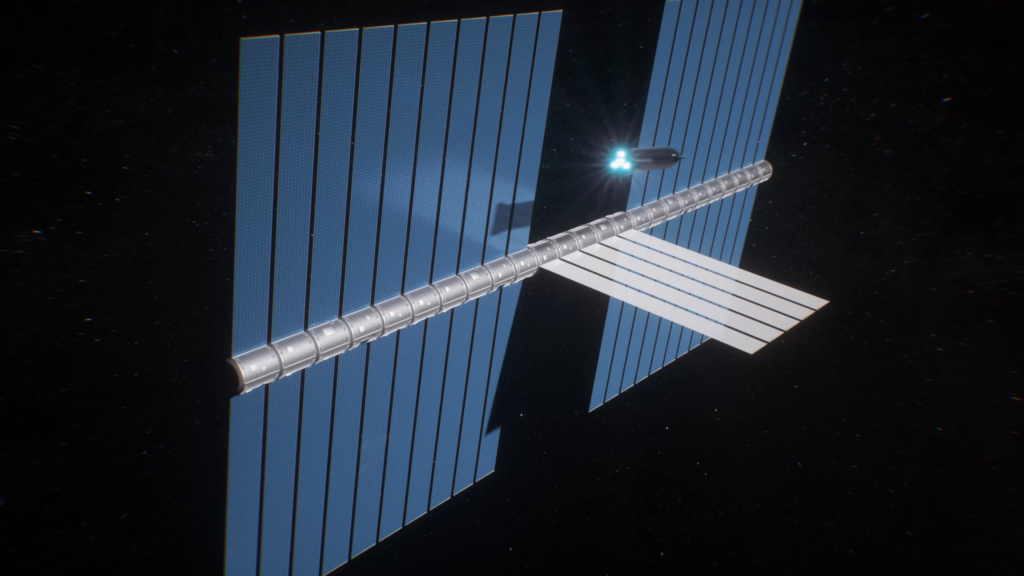
Part two: large-scale application. A hypothetical space data center deploys solar panels and radiators of impressive scale. SpaceX’s Starship passes in the foreground — not for glamour, but to provide an immediately readable size reference for any viewer.
Technical choices
The entire animation was produced in Houdini, rendered with the Octane plugin at 4K.
Houdini was the obvious choice for one core reason: procedural modeling. The extruding resin tube, the antennas, the space station structure — everything that didn’t exist as a CAD file was built procedurally, allowing parameters (length, shape, density) to be adjusted without rebuilding from scratch.
The Starship and base satellite models were purchased from a library to save time on reference elements. The printer itself was modeled from a simplified CAD file provided by Orbital Matter. Everything else — structure, environment, dynamics — was modeled and animated in Houdini.
What this project demonstrates
Orbital Matter applies in orbit the same principle as concrete on Earth: a liquid material, shaped on-site, curing into a permanent structure. A crystal-clear idea — as long as you can show it at the scale where it makes sense.
That’s what 3D animation does for deep tech and space startups: it transforms technology that works in the lab into something investors, partners, and clients can visualize at real scale — before the first flight.
If you are a startup, work in defense communication, aerospace, or military media and need visual content that’s technically grounded and visually compelling —let’s talk.
Client : orbitalmatter.com
Motion design : Vincent Corlaix
Music : Fabrice Vavasseur